

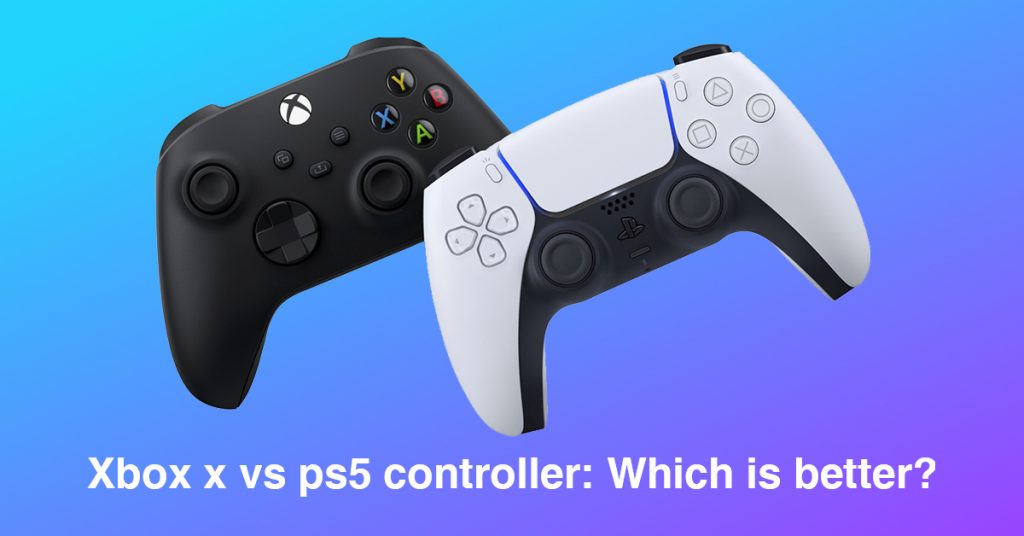
When choosing between a PS5 and an Xbox Series X, most buyers compare teraflops and storage speeds. But for the hours you actually spend gaming, nothing shapes the experience more directly than what’s in your hands. This is a focused comparison of the DualSense and the Xbox Wireless Controller across every category that matters — design, features, comfort, battery, price, and real-world feel.
Design and Appearance
The two controllers took opposite directions with this generation.
Sony moved away from the traditional DualShock design entirely. The DualSense features a white color scheme with a black central area, and its face buttons are now transparent, giving the controller a more premium look. The DualSense smoothed out bumps and ridges from the DualShock 4 and ended up slightly smaller and closer in form to the Xbox controller, while still being recognizable as a PlayStation controller.
Microsoft stuck with a familiar design philosophy for the Xbox Wireless Controller. There are minor changes, but it is mostly the same as the controller that shipped with the Xbox One — the two are almost indistinguishable at a glance.
For players switching from PlayStation, the DualSense feels like a meaningful upgrade in hand. For Xbox players, the new controller will feel immediately familiar — which is either a comfort or a missed opportunity depending on your perspective.
Haptic Feedback and Adaptive Triggers
This is where the gap between the two controllers is most significant.
The DualSense replaces traditional rumble motors with haptic feedback — precise vibration that can simulate specific textures, surfaces, and impacts rather than a generic buzz. Pulling a bowstring, driving on gravel, or getting hit by rain all feel distinctly different. Games built specifically around this feature — like Astro’s Playroom, which comes pre-installed on every PS5 — showcase the difference immediately.
Adaptive triggers on the DualSense dynamically change the resistance of the L2 and R2 buttons depending on what is happening in the game. Braking hard in a racing game, firing different weapon types, or drawing back a bow all carry different physical resistance through the trigger. It is the most genuinely new controller feature of this console generation.
The Xbox Series X controller also uses haptic feedback, a more advanced type of rumble technology than previous generations. However, it does not have adaptive triggers, and the haptic implementation is less precise than the DualSense. For players who have used both, the DualSense’s tactile range is noticeably wider.
Winner: DualSense — by a significant margin for players who value immersion.
Unique Features
The DualSense includes motion controls, a built-in microphone used for both communication and gameplay, and a rechargeable internal battery. The Xbox Series X controller does not have motion controls.
The DualSense’s built-in microphone means you can jump into party chat without a headset — useful for casual sessions. The Create button replaces the Share button and allows instant content capture and sharing without navigating menus.
The Xbox Wireless Controller adds a dedicated Share button for content capture and features Dynamic Latency Input, which reduces input lag by synchronizing controller input with display output. Xbox One accessories, including older controllers, are compatible with the Xbox Series X, which is not the case for the PS5 — the DualSense cannot be used with a PS4 at all.
Winner: DualSense on features. Xbox on backward accessory compatibility.
Comfort and Ergonomics
Both controllers feel great in hand, but the DualSense and Xbox Wireless Controller have unique designs that significantly affect ergonomics and comfort. The Xbox controller fits snugly in most hands, with analog sticks positioned so thumbs can easily reach them, and its buttons feel more tactile and durable — making it well suited for intense gaming sessions.
The DualSense is notably larger than the DualShock 4 and has a more ergonomic grip profile. Players with larger hands tend to find it more comfortable than previous PlayStation controllers. Players with smaller hands may find the Xbox controller a better fit.
Comfort is subjective, but the Xbox controller has decades of refinement behind its current shape — many players consider it the ergonomic benchmark for the industry.
Winner: Personal preference. Xbox for small-to-medium hands. DualSense for medium-to-large.
Battery Life
The DualSense uses a rechargeable internal battery, while the Xbox Series X controller uses AA batteries.
This is one of the most debated differences between the two. The DualSense charges via USB-C and offers approximately 12 hours of play per charge — shorter than many players would prefer. The Xbox controller running on AA batteries lasts significantly longer before needing attention, and you can swap batteries instantly without interrupting a session. A rechargeable battery pack is available as an add-on, which most dedicated Xbox players purchase separately.
Winner: Xbox for longevity and flexibility. DualSense for convenience (no spare batteries needed).
Price
The PS5 DualSense retails at around $69.99, while the Xbox Series X controller is typically sold at $59.99. Purchasing the Xbox controller with the rechargeable battery pack adds approximately $24.99, bringing the cost closer to the DualSense. The Xbox Elite Wireless Controller Series 2 is available at $179.99, offering premium build quality, greater customization, and rechargeable battery.
The DualSense Edge, launched in 2023, offers additional function buttons and a higher quality build at a premium price, though with slightly reduced battery life compared to the standard DualSense.
Winner: Xbox at base price. Comparable once you add a rechargeable battery pack.
PC Compatibility
Both controllers work with Windows PCs via USB or Bluetooth. The Xbox Wireless Controller has historically had the edge here due to native Windows support and Xbox Wireless protocol. DualSense PC support has improved significantly through Steam and third-party tools, with haptic feedback and adaptive triggers functional in an increasing number of PC titles.
Winner: Xbox for plug-and-play simplicity. DualSense closing the gap on Steam.
Category Scorecard
| Category | DualSense | Xbox Wireless Controller |
|---|---|---|
| Haptic feedback | Best in class | Good, less precise |
| Adaptive triggers | Yes | No |
| Motion controls | Yes | No |
| Built-in microphone | Yes | No |
| Battery life | ~12 hours (built-in) | Longer (AA or pack) |
| Ergonomics | Excellent for larger hands | Excellent for most hand sizes |
| Accessory compatibility | PS5 only | Works with Xbox One accessories |
| Base price | $69.99 | $59.99 |
| PC support | Good (improving) | Excellent (native) |
Which Controller Is Better?
The DualSense wins on innovation. Haptic feedback, adaptive triggers, motion controls, and a built-in microphone make it the more feature-rich controller of this generation — and when those features are used well by developers, they create experiences that genuinely feel different from anything available on previous hardware.
The Xbox Wireless Controller wins on consistency. It is comfortable for virtually everyone, has better battery flexibility, broader accessory compatibility, and superior PC support out of the box. For players who prioritize reliability over novelty, it remains one of the best controllers ever made.
Neither is the wrong choice. The right one depends on what you value most in a gaming session.
Ready to Upgrade? Sell Your Current Console or Controller
If you’re switching platforms or upgrading to the PS5 Pro or a new Xbox model, Gizmogo buys gaming consoles in any condition. Get an instant quote, ship for free, and receive payment within 24 hours.
Frequently Asked Questions
Is the PS5 DualSense better than the Xbox Series X controller?
For immersive features like haptic feedback and adaptive triggers, the DualSense leads this generation. For ergonomics, battery life, and PC compatibility, the Xbox Wireless Controller holds its own. Which is better depends on what you prioritize.
Does the Xbox Series X controller have adaptive triggers?
No. Adaptive triggers are exclusive to the PS5 DualSense. The Xbox controller has haptic rumble in its triggers but does not dynamically adjust resistance.
Does the DualSense work on PC?
Yes, with increasing support through Steam and third-party software. Haptic feedback and adaptive triggers work in compatible PC titles, though Xbox controllers still have broader native Windows support.
How long does the PS5 DualSense battery last?
The DualSense internal battery lasts approximately 12 hours per charge via USB-C — shorter than many players prefer. The Xbox controller running AA batteries lasts considerably longer.
Can I use my old Xbox controller on Xbox Series X?
Yes. The Xbox Series X is backward compatible with Xbox One controllers and accessories. The PS5 DualSense is not compatible with PS4.
Where can I sell my PS5 or Xbox before upgrading?
Gizmogo offers instant quotes, free prepaid shipping, and fast payment for gaming consoles in any condition.